

Welcome to BrashTalk #35
The Newsletter of the PTGA
In this issue:
- Opening Messagefrom Colby Brokvist, PTGA Board Chair
- Updates
- Antarctic Season Resource Toolkit: Stay Tuned!
- Thank you to Graham Charles!
- Scuttlebutt
- PTGA Merchandise
- PhD Survey – Antarctic and subantarctic community values
- UKAHT Useful Webinars
- Polar Bears International Resources
- Training and Development
- Anchoring Tips & Tricks
- Guano Happens
- Close Call: Ice Ahead
- Guide Interview
- Hanna Michel
- PTGA Guide Status Updates

Hello fellow guides and polar staff,
Coming out of this year’s AGM, and with a new 3-year Strategic Plan in hand, I’d like to update you on PTGA’s recent work and future initiatives. First, I’m struck by how solidly our association now stands in the polar tourism landscape. Ten years of steady effort have built a strong network of status guides and members, active partnerships with a multitude of trip operators and training institutes, and meaningful relationships with IAATO, AECO, and others shaping the future of our industry. PTGA has truly become a voice for guide competency: helping define what professional polar guiding looks like, supporting your work in the field, and keeping the guided experience at the center of broader industry conversations.
Recent progress within both the field and office realms of our operations reflects the steady leadership of Sarah, whose work as Executive Director continues to give PTGA structure and momentum. This summer also brought important continuity and focus to our assessment program with Stephi stepping into the Program Director role. As PTGA has grown, so has the depth and complexity of the work: fostering community for polar guides, improving access to certification assessments, strengthening partnerships, and staying closely involved in the ongoing guide standards conversations taking place across both polar regions. Having Sarah and Stephi in their roles gives PTGA a strong operational and networking foundation for the work ahead.
We’ve also increased the number and diversity of our Board, with the newest additions arriving from outside the polar industry, having backgrounds in non-profit leadership, small business management, and leadership education.
If you’d like to better know the Board, you can see the current listing of personalities here.
At its core, PTGA’s real value remains rooted with you in the field. Our 2026-29 strategic plan builds from those roots. A main priority is supporting you by expanding skills enrichment and assessment opportunities, and continuing to serve as a professional community that reflects the quality and skill of the work we do, and the professional friendships that we hold dear.
Thank you for being here, and I look forward to our paths crossing in one icy place or another.
Sincerely,
Colby, Chair of the Board


STAY TUNED: Antarctic 2026-27 Season
Resource Toolkit
This year, PTGA is running pre-season prep a little differently. Instead of one live summit, we’re putting together a toolkit: a resource document covering what’s new this season, a series of short video interviews with IAATO staff and Expedition Leaders, and a live online Guide Gathering to connect with fellow guides before you head south.
We want all of this to reflect what you actually want to know and who you want to hear from, so we’d love your input. It’ll only take a few minutes, thank you for helping us shape this.
Stay tuned for more updates within the next week with more details!
Please complete this survey to tell us what you really would like to know to prepare for the Antarctic season!

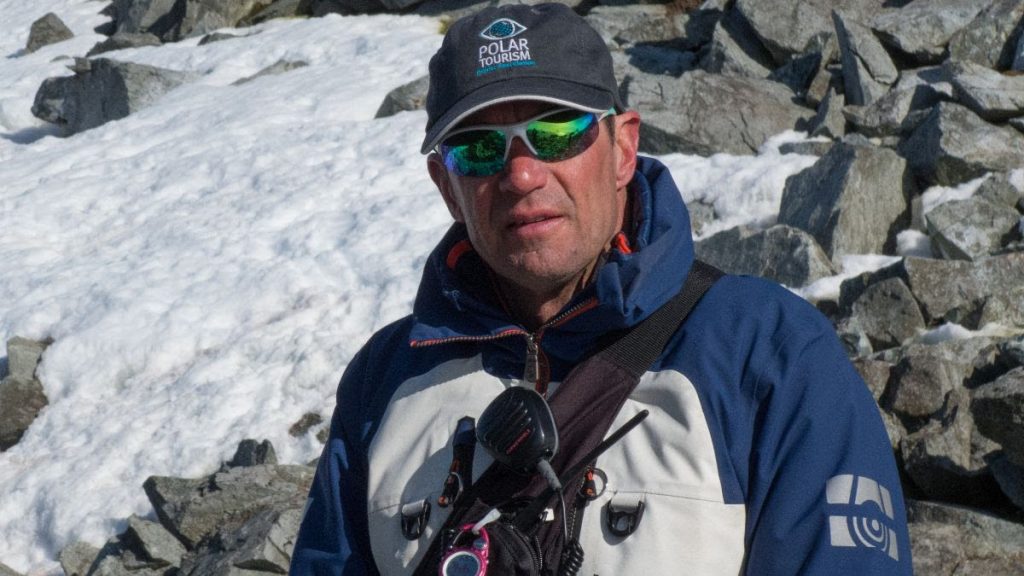
Thank you to Graham Charles!
Over a decade ago, Graham was talking about building this set of industry benchmarks and many of us were curious. I was just getting into the industry at that time and I remember him handing me a word document draft of qualifications while I was learning the ins and outs of Antarctic Expedition Guiding. That early draft turned into the robust qualification framework we now have today.
Because of Graham’s work starting the PTGA, over 475 guides have received certification as Polar Guide or Senior Polar Guide. Graham started this by working for free. Then he put his own savings into it. Then he built an organization that could self-sustain with a small but mighty staff team, a committed board of directors and advisory board, 70+ Assessors, 800+ individual members, 4 Affiliate Members, 6 Accredited Providers, and 6 Training and Assessment Providers – all of it moving the PTGA forward.
One of our Senior Polar Guides and Assessors, Ewan Blyth shared a reflection to our group of Assessors that captured it all so well:
“Eleven years ago, this was beyond a pipe dream. It was one possible outcome of thousands of hours of your work — and thousands of hours from people you convinced to join something no one could quite fathom yet. I don’t think any of us truly understand what you’ve given up to make this real. You pushed on when few believed in the vision. You pushed on through doubt, database hell and not a cent to fund any of the work. The snowball you’ve built from snowflakes of wanting and willing is testament to your endurance, your vision, your sheer will. Each of us here who values professionalism, safety, and the drive to be better is indebted to you.”
We recently transitioned leadership so the organization can thrive in this next chapter. Graham moved out of his staff role in early September and remains on the Board of Directors as an advisor. Stephi is thriving in the Program Director role and I’m honored to be here as Executive Director. Everything we’re doing, everything we want to do for members and the community, was built on the foundation Graham dreamed into existence. Thank you, Graham!
Sarah Merusi
Executive Director, PTGA
PTGA Merch!
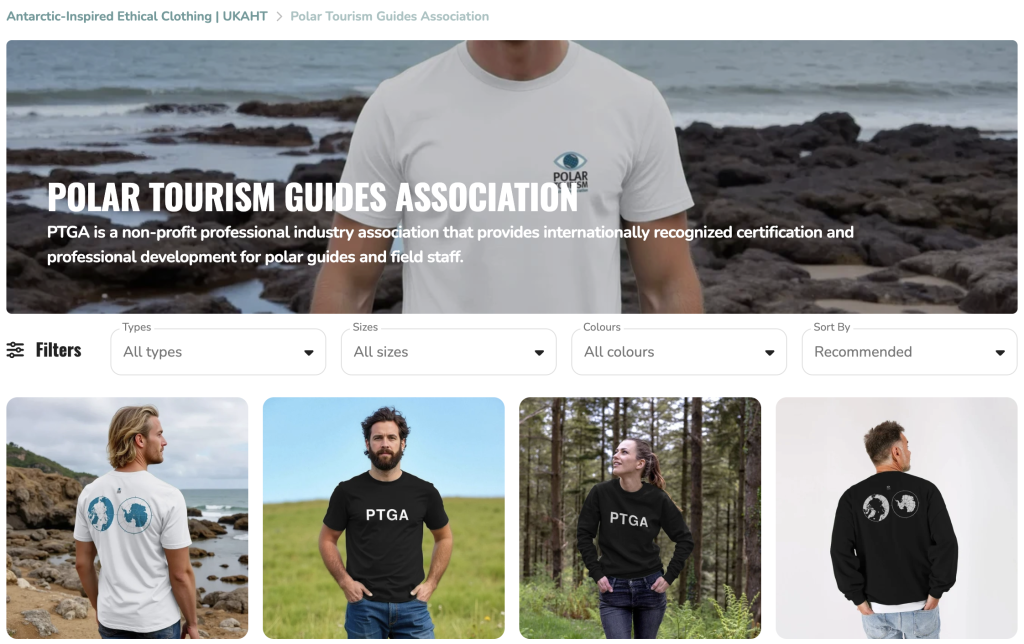
You’ve asked, we listened! Members have been asking for years to be able to represent the community we’re a part of with merch. The PTGA has recently collaborated with the UK Antarctic Heritage Trust (UKAHT) to bring an online merch shop to our international community. Teemill is a sustainable print-on-demand supplier known for quality items. Wherever you’re based, you’re covered: Teemill ships worldwide and handles customer service and returns directly.
PhD Survey:
Antarctic and subantarctic community values
You are invited to participate in a short 10-15 minute online survey for Caitlin Harvey’s PhD project. Caitlin is a PhD candidate at the University of Tasmania, completing a project on the impacts of climate change on Antarctic and subantarctic heritage. This part of the project looks at the community and social values associated with several Antarctic and subantarctic heritage places, including Macquarie Island, Heard and McDonald Islands, Cape Denison and Mawson’s Huts, Mawson Station, Wilkes Station, Casey Station and Davis Station.
Who should take the survey?
Anyone from within the Antarctic/subantarctic sector who has any kind of past or present involvement with the heritage places listed above (e.g. research, management, policy). It doesn’t need to be your full-time job and you do not need to have visited these places in person. I encourage responses from multiple people in the same organisation.
How does someone participate?
To take the survey, follow this link. The survey closes on 2 October 2026 at 11:45pm.
Top 5 Antarctic Resources for Guides
from the UK Antarctic Heritage Trust
We asked the team at UKAHT to share with us their top resources for guides to check out this upcoming season and here’s what they shared:
5. A Virtual tour around Port Lockroy: https://ukaht.org/virtual-
4. A VR experience that takes you back to Stonington in 1965 (for those who have Meta Quest headsets): https://www.meta.com/en-gb/
3. Six seasons of UKAHT’s podcast: https://ukaht.org/discover/
2. A bit on UKAHT’s website that gives the essential history and facts about each of their sites (with pictures): https://ukaht.org/places/
1. YouTube channel packed with everything from previous episodes of their webinars to short films and soon a series of animated shorts that will explain everything from the history of Antarctica to their sites and beyond: https://www.youtube.com/@
Polar Bears International
The team at Polar Bears International shared some upcoming events and opportunities:
Citizen science opportunity: polar bears and tourism
Guests can take part in a study to quantify interactions between tourism activity and polar bears. This research by Dr. Brooke Biddlecombe at the University of Alberta in collaboration with Polar Bears International uses an app to record GPS tracks of tours and polar bear sightings. The results will inform guidelines for responsible, sustainable polar bear tourism.
To find out how you can get involved, email Brooke at bbiddlec@ualberta.ca.
The Polar Bear Handbook for Guides, 2nd edition is now available
Get the Handbook here: https://
Join the next Polar Bears International webinar for Arctic guides
Join this free webinar for all guides and operators working in polar bear tourism, with a focus on the Churchill area. Special guest Evan Richardson from Environment and Climate Change Canada will join to share the latest on his research in the Hudson Bay region.
Tuesday, October 6, 2026
North America: 2pm Pacific / 3pm Mountain / 4pm Central / 5pm Eastern
Register here: https://
Receive This Newsletter in Your Inbox!
Be in the know. Opt in to receive Brash Talk directly in your email.

Anchoring Tips and Tricks
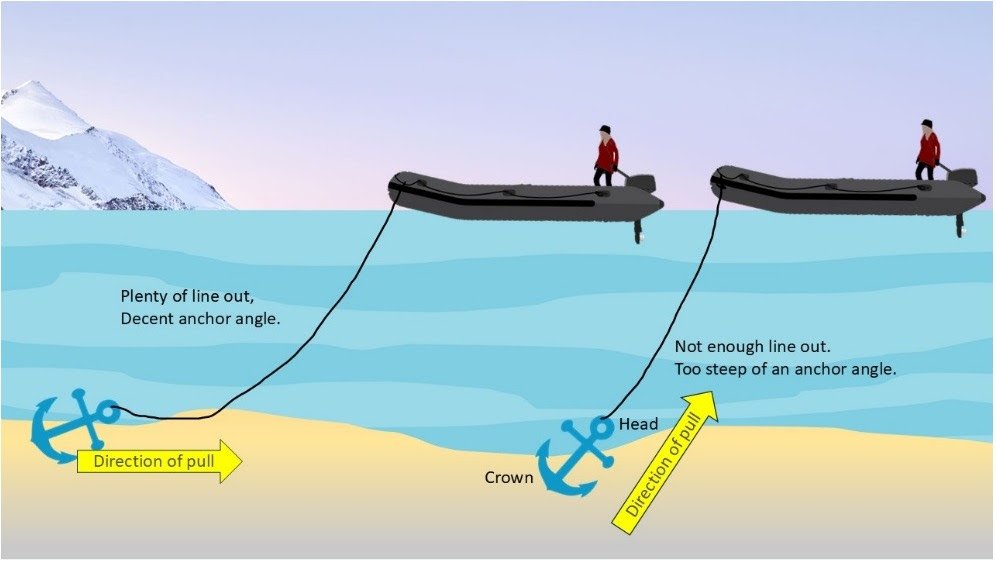
It’s always nice when you get taught the magical ratio for how much line to put in the water depending on how deep you’re anchoring, and while it’d be great to know that we were in exactly 15ft of water and needed 45-100ft of anchor line to have a nice 3:1 or 6:1 ratio…the reality is that nearly every zodiac I’ve ever worked on has never had nearly enough anchor line, and half of them don’t have chain. It just isn’t realistic in the expedition industry to carry an anchor locker on a zodiac with 100ft of rope and chain. So how are we meant to anchor in anything other than fair conditions with the tools we have?
Generally speaking, for fair weather excursions, as long as you aren’t dropping your anchor in really deep water, or near a drop off, the anchors are sufficient enough to hold zodiacs in place for the duration of the excursion. The key to an anchor holding is weight and length of the line. If in doubt, let it out! If you are anchoring in deeper water, just let out all your line…the worst that will happen is someone has to haul in an extra 15ft of rope. If you tie off your anchor line short, now you are potentially dealing with anchors dragging and pulling staff off shore ops to go chase down rogue zodiacs. Unless there is a specific reason for not letting out all of your anchor line (like swing room for example), just let out the line. The more line out means the better the holding power. If your anchor has chain on it, that will help weigh it down and act as a spring.
But what about when weather isn’t as great. There is a fine balance between fighting with anchors, and just using a human in a boat. Sometimes, the best anchor is someone sitting in a raft of boats with the engine reversing into the wind. If your anchors are dragging anyway, you will have to have someone in a boat chasing down and resetting anchors, so why not just skip a step and leave that person on the water as the boat-keeper. Yes, it pulls a staff member away from the shoreline, but also it means you don’t have to have a staff sitting around worrying about anchors.
If that is not feasible, sometimes you just need to try to get those anchors to hold. Reducing the angle of the anchor line by going in shallower will certainly help. If you really need to, you can always try adding more line if you have it available. For a proper storm anchor, the ideal amount of anchor line to depth is 7:1 (70ft of line for 10ft of depth). I doubt it might ever be achievable, but you could certainly try with what you’ve got. I would also avoid clipping multiple boats to a single anchored boat… there is just too much pull for our wee little anchors. The alternative to all of this is to anchor on shore…
Click Read More to see the rest of the Training piece!

This edition of Guano Happens shares a close call that will probably feel familiar to many Zodiac drivers. It is a useful reminder that operating small boats in polar environments demands continuous attention – not just to what is immediately around us, but to what is developing ahead.
In Daniel Kahneman’s Book, Thinking, Fast and Slow, this is System 2 thinking: deliberate, effortful attention. When driving around ice, that attention needs to remain focused on the task.
What Happened?
We were operating at Neko Harbour and I was taking a group of ice-loving guests on an extended Zodiac cruise. Another driver and I had been out for around two hours while the rest of the guests were ashore.
There was plenty of ice around – larger pieces and bergy bits scattered throughout the area – so careful navigation was required.
We were heading back toward the ship at a relatively fast pace when I noticed the crane strop becoming tangled around my right ankle. It was uncomfortable and I started trying to kick it away. With this operator, the strops remain attached to the U-bolts rather than being removed and stored.
My attention shifted from driving to the strop.
Suddenly, the guest sitting closest to me tapped my leg. We were heading directly toward a large piece of ice – at speed.
For those few seconds, I had completely lost awareness of what was ahead of the Zodiac. If the guest hadn’t noticed, we likely would have hit the ice head-on.
I immediately altered course and avoided the ice. Fortunately, apart from me and the guest who alerted me, nobody appeared to notice what had happened.
Lesson
The obvious lesson is simple:
When you are driving, drive.
The strop was a distraction, but the critical issue was allowing that distraction to take the driver’s attention away from the primary task.
In an ice environment, even a few seconds of lost attention can matter. At speed, the available time to see, understand and respond reduces rapidly.

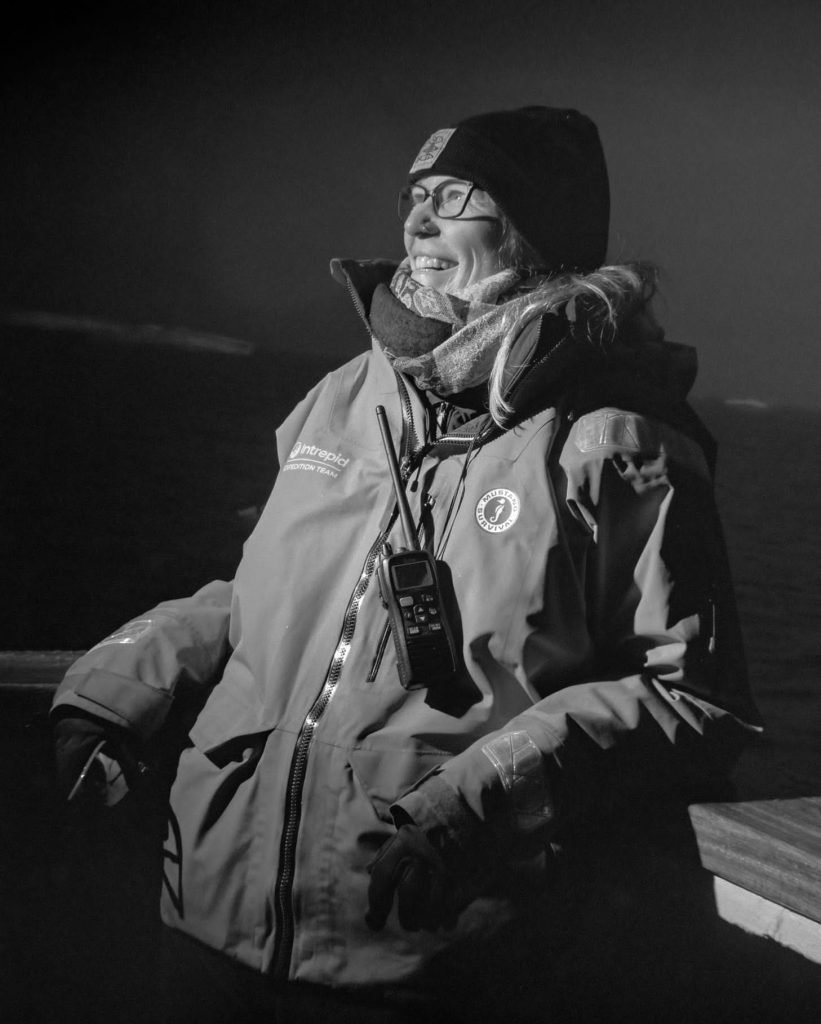
Born and raised in Germany, Hanna is a lifelong advocate for marine mammals who discovered her love for these creatures at an early age. She holds a Master’s degree in biology, earned through research projects on cetaceans in Italy, Australia, and Iceland – a country she called home for several years, working as a naturalist guide for whale-watching companies. Hanna is a PTGA Senior Polar Guide and Assessor and has been guiding in the polar regions since 2017, driven by a deep passion for wildlife and conservation and a desire to connect people with the natural world.
PTGA: This is often a tough question for polar guides: where are you from, and where do you live?!
Hanna: I’m originally from Germany, and when I’m not working, I make regular trips back to visit friends and family. The rest of the time, I’m in Spain with my boyfriend and our new fur baby (AKA dog).
PTGA: Tell us how you found your way into working in the polar regions.
Hanna: Ever since I can remember, I’ve been fascinated by whales and dolphins. After finishing my Master’s in biology, I worked as a whale watching guide in Iceland for a couple of years. One summer, a colleague mentioned he’d landed a job on expedition cruises to Antarctica. We stayed in touch, he sent photos, and the following season I applied, and we ended up working together on the same vessel (if you’re reading this, thank you, Rémi). The rest is history.
PTGA: You’ve worked with a few different operators over your years in the industry. What have you learnt from working with different operators, different cultures and different SOPs?
Hanna: The job itself is essentially the same wherever you go, but the atmosphere, culture, and focus of the operator can be very different. More than anything, those experiences have taught me a lot about myself, what I need to feel comfortable and supported, what kind of approach and values I look for in a company, and what leadership style I appreciate. I’ve also come to realize how much I value operators who prioritize science communication, citizen science programs, and education in general.
PTGA: You became a PTGA Assessor a couple of years ago. What has that transition been like, going from being a Senior Polar Guide to assessing your peers?
Hanna: Becoming an assessor wasn’t something I had considered until one of my own assessors encouraged me to pursue the training. It has been a rewarding experience. There is always something to take away from an assessment, and that continuous learning helps me grow both as an assessor and as a guide. I also find the PTGA framework invaluable in maintaining a clear and professional boundary between the assessor-assessee relationship and personal friendship.
PTGA: Hanna, after years in the industry, you’ve recently been taking on more leadership contracts. What has that transition been like for you, and what have you found useful in preparing for those roles?
Click Read More to see the rest of the interview!
You can find a list of our PTGA Accredited Providers here, PTGA Affiliate Members here, and our PTGA Training and Assessment Providers here.
PTGA Members – 800
Senior Polar Guides – 244
Polar Guides – 231
Polar Guide (Aspirant) – 123
Provisional and Full Assessors – 68
Senior Assessors – 6
Congratulations to our new status guides!
Polar Guide (Aspirant)
Alejandro Greca, David Pavlacek, Felipe Menzella, Katerina Lebedeva, Simon Ager, Tamara Cracknell
Polar Guide
Pablo Zenteno, Elisaveta (Lisa) Dombrovski, Tansy Wilkinson
Senior Polar Guide
Andres Garcia Diaz
New Assessor: Marcos Goldin


